Your radiology team juggles studies from multiple hospitals, yet many platforms still force you to chase images through email or USB drives. That extra step adds time and breaks the chain of care when speed matters most. Medicai replaces those scattered tools with one cloud workspace that covers retrieval, viewing, and sharing.
By the end of this article you will know how the platform's cloud PACS, zero-footprint viewer, and AI-supported workflows cut out those hand-offs, plus who it fits and what the pricing tiers look like before you test it.
What Is Medicai?
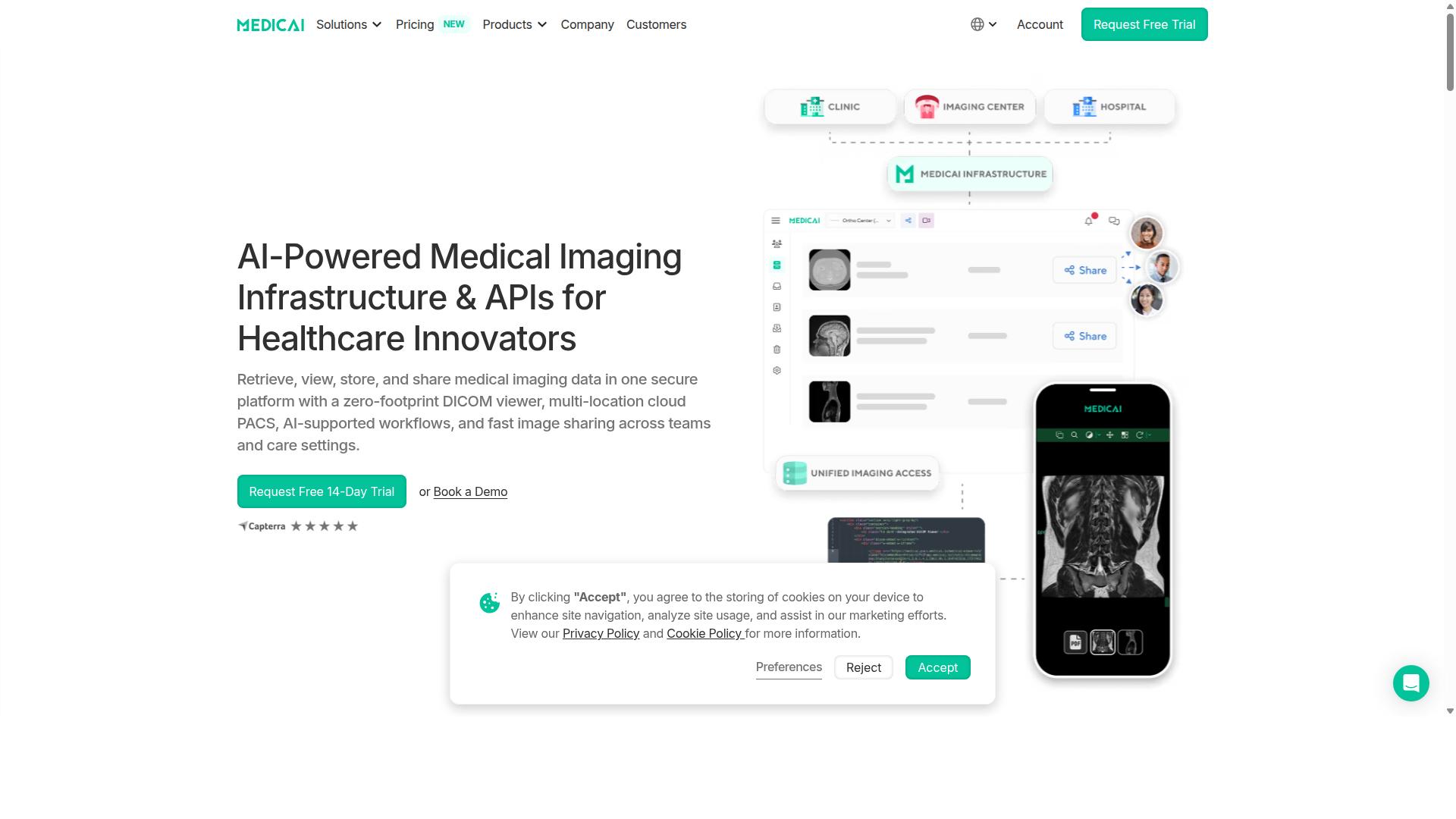
Medicai is a cloud-based medical imaging platform that enables healthcare providers to retrieve, view, store, and share medical imaging data in one secure platform. The SaaS architecture removes the need for local DICOM servers and supports scalable imaging across healthcare organizations.
A zero-footprint viewer allows radiologists and referring physicians to access studies without installing software. This approach reduces IT overhead and speeds up image access across clinical teams.
The platform offers Imaging Infrastructure as a Service, connecting radiology departments to referring physicians through a single dashboard. This setup supports multi-location cloud PACS and improves image sharing across different sites and care settings.
AI-supported workflows help teams manage diagnostic tasks while maintaining interoperability across systems. Fast image sharing reduces delays between departments and supports better coordination in radiology management.
Why Medicai Is Best for Scalable Radiology Management
Growth in imaging volume demands an infrastructure that expands without hardware purchases or downtime. Radiology management requires systems that handle increasing study volumes while maintaining consistent performance across multiple locations.
Real-time workload balancing across distributed radiologists helps practices manage peak demand periods effectively. This approach allows studies to route automatically to available specialists regardless of their physical location.
Automatic replication to geographically separate data centers ensures continuous access to patient imaging data. When one facility experiences technical issues, others maintain full operational capacity without interruption.
The ability to onboard new facilities in hours rather than weeks supports rapid practice expansion. Scalable imaging platforms reduce the time needed to integrate additional sites into existing workflows.
Cloud-based architecture eliminates the need for local server investments when adding capacity. Medical imaging departments can increase their diagnostic capabilities without significant capital expenditure on physical infrastructure.
Multi-site deployment becomes straightforward when systems support standardized protocols across locations. Radiology software that accommodates different facility requirements while maintaining unified operations provides practical advantages for growing practices.
Enterprise imaging benefits from solutions that scale both horizontally across sites and vertically with increased study complexity. Diagnostic efficiency improves when additional resources work together without disrupting established procedures.
Key Features and What Makes Medicai Stand Out
The platform's feature set is organized around the daily workflow of acquisition, interpretation, and collaboration. Each component targets a specific pain point in radiology management, from image intake speed to report turnaround. Together, these tools create a scalable imaging environment that supports both small clinics and large hospital networks.
Cloud PACS and Vendor Neutral Archive focus on secure, accessible storage. Zero-Footprint DICOM Viewer and Structured Reporting streamline interpretation and documentation. AI-Supported Workflows and API Transactions reduce repetitive tasks and speed up data exchange. Each feature directly improves diagnostic efficiency and reduces administrative overhead.
Cloud PACS and Vendor Neutral Archive
Instead of on-premise servers, Medicai hosts a vendor-neutral archive that stores DICOM and non-DICOM files with AES-256 encryption at rest. Automatic disaster-recovery replication between AWS and Azure regions keeps data available during outages. Retention policies configurable down to the study level give administrators precise control over storage costs.
The archive supports both native DICOMweb and legacy C-STORE, allowing seamless PACS integration with existing modalities. Multi-site hospitals can centralize imaging across locations without additional hardware purchases. This approach simplifies enterprise imaging and supports teleradiology workflows that require fast image retrieval.
Backup and disaster recovery features protect patient data while meeting HIPAA and GDPR requirements. Secure storage frees IT teams from maintaining on-site servers and reduces the risk of data loss.
Zero-Footprint DICOM Viewer and Structured Reporting
The HTML5 viewer renders full-resolution studies instantly in any browser, including mobile devices, without plug-ins. Built-in hanging protocols and multiplanar reconstruction support accurate interpretation across different modalities. Radiologists can review imaging analytics and measurements directly within the same interface.
One-click export of structured reports embeds key images and measurements into HL7 FHIR resources. This automation eliminates manual data entry and ensures that reports flow directly into the EMR system. Radiology reporting becomes faster and more consistent across the care team.
The Medicai Imaging API enables external systems to pull images and reports as needed, supporting real-time collaboration between specialists. Patient data stays protected through OWASP security guidelines and FDA-cleared viewers.
AI-Supported Workflows and API Transactions
Machine-learning outputs from FDA-cleared tools are ingested via a RESTful API. Real-time inference results display as overlays, helping radiologists spot critical findings quickly. Automated pre-fetching of priors based on AI triage scores reduces time spent searching for comparison studies.
Quantitative biomarkers push back into the EMR without extra clicks, supporting AI-assisted diagnosis and workload balancing. The Radiology AI Co-Pilot integrates with existing workflows, allowing teams to scale without adding staff.
API transactions also enable image sharing between clinics and hospitals currently on the platform. This connectivity supports tumor boards and multi-site deployment without custom development. Diagnostic efficiency improves because AI handles routine tasks while radiologists focus on complex cases.
Pricing and Plans
Two subscription tiers accommodate both independent practices and enterprise health systems. The Starter plan provides 500 GB storage with unlimited user accounts, while the Standard plan expands capacity to 2 TB with one connected location included.
Monthly pricing starts at $249 for Starter and $749 for Standard. Enterprise customers receive custom pricing based on specific storage requirements and the number of connected locations needed.
Yearly billing offers 15% savings on both subscription tiers. Starter drops to $209 monthly, while Standard reduces to $639 per month when paid annually.
Overages follow transparent billing at per 100 GB increments. This structure prevents unexpected costs as imaging volumes grow across radiology departments.
A one-time $1,000 DICOM Gateway setup fee applies per location. Enterprise customers can also access per-study pricing when their workflow requires this flexibility.
Medicai offers a 14-day trial of Starter features without requiring a credit card. This allows radiology teams to evaluate the platform before committing to a subscription.
Refunds are not available for partial billing periods. Organizations can scale from Starter through Standard to Enterprise as imaging demands increase.
Trust Signals
Compliance certifications and uptime metrics provide measurable proof that patient data remains secure and available. Healthcare organizations evaluating radiology management solutions need concrete evidence of security standards before committing to any platform.
HIPAA and GDPR compliance form the foundation of Medicai data protection practices. These certifications demonstrate that patient information receives protection under both United States and European regulatory frameworks. Medical facilities handling sensitive imaging data require this level of security assurance.
FDA 510(k) clearance for the viewer adds another layer of validation. This regulatory approval confirms that the imaging software meets established safety and effectiveness standards for diagnostic use. Hospitals and clinics rely on cleared devices for clinical decision-making.
The 99.95 percent uptime SLA reflects infrastructure reliability through redundant Microsoft Azure and AWS systems. This architecture ensures that radiology workflows continue uninterrupted during peak usage periods. Scalable imaging operations depend on consistent system availability across multiple sites.
These trust signals become essential when organizations manage enterprise imaging at scale. Multi-site deployments require platforms that maintain security standards while supporting growing volumes of medical imaging data. The combination of regulatory compliance and infrastructure redundancy addresses core concerns for radiology departments handling increasing diagnostic workloads.
Who Should Use Medicai
Any healthcare provider that generates or consumes medical images can benefit from a cloud-native archive and viewer. The Medicai platform serves hospitals, imaging centers, and specialty care providers across multiple disciplines.
Specialties that rely on diagnostic imaging include orthopedics, neurology, and oncology. These groups need reliable access to scans for treatment planning and follow-up care.
Radiology, cardiology, and ophthalmology departments use the system for daily interpretation workflows. Ob-gyn, pulmonology, and dentistry practices also depend on medical imaging for patient management.
Gastroenterology teams require image storage and sharing capabilities for endoscopic and radiologic studies. Telehealth groups depend on cross-border image exchange to connect patients with remote specialists.
The platform addresses needs of virtual care providers, telemedicine platforms, and teleradiology services. Personal injury lawyers access imaging records for documentation. Tumor boards and clinical trials benefit from centralized viewing. Medical education organizations use the archive for teaching purposes. Patients connect through the Patient Portal for direct access to their studies.
Final Verdict
Medicai removes hardware constraints while adding AI-assisted speed and enterprise-grade compliance. Legacy PACS systems often tie organizations to expensive maintenance contracts that limit growth and drain budgets. Moving away from these arrangements frees capital for innovation and reduces ongoing operational costs.
The Medicai platform delivers cloud-based radiology management that scales across multiple sites without additional infrastructure investments. This approach eliminates the need for on-premise servers and their associated upkeep expenses. Organizations gain access to modern diagnostic tools while avoiding the hidden costs of legacy system upgrades.
Contact Medicai USA at +1 (832) 220 1035 or Medicai Romania at +40 316 305 875 to discuss implementation. The sales team at sales@medicai.org handles inquiries about deployment timelines and pricing structures. Contract signing takes place at the St. Petersburg location, 7901 4th St N, STE 300, or the Bucharest office at 53-55 N Filipescu, 5th Floor.