Most radiologists choosing between AWS HealthImaging and Medicai must decide which platform actually delivers zero-footprint diagnostic viewing without extra software. The first option requires integration layers and separate viewer tools. The second option bundles storage, exchange, and viewing in one system.
By the final section you will know exactly which platform meets each of the outlined criteria and which team profile fits the remaining choice. The comparison covers viewer performance, multi-location exchange, AI-supported reporting, and pricing structure.
Quick Verdict: Medicai Wins for Zero-Footprint Diagnostic Viewing
Medicai's zero-footprint viewer delivers faster rendering and simpler access than AWS HealthImaging for most diagnostic imaging workflows. The platform loads studies directly in web browsers without additional software. Users access images from any device with standard internet connectivity.
- Viewer performance: Medicai renders DICOM studies quickly in browsers, while AWS HealthImaging requires additional configuration for consistent results across different network conditions.
- Deployment model: Medicai operates as a cloud-native SaaS platform with Microsoft Azure partnership, whereas AWS HealthImaging stays tied to Amazon infrastructure and may create vendor considerations during migration.
- HIPAA compliance: Medicai maintains HIPAA and GDPR compliance with OWASP security guidelines, while AWS HealthImaging offers general cloud security features that require separate configuration for medical use cases.
- Proven scale: Medicai has completed 300k+ visualizations of DICOM studies in the last year and holds FDA/CEE cleared viewers, while AWS HealthImaging lacks published medical imaging workflow statistics.
These factors make Medicai the stronger choice for radiology workflows that need quick access. The platform supports 10,000+ active doctors across 70 clinics and hospitals. Organizations benefit from established interoperability through 50M+ yearly API transactions.
At a glance: how Medicai compares to AWS HealthImaging on the features that matter most.
| Feature | Medicai | AWS HealthImaging |
|---|---|---|
| Zero-Footprint Diagnostic Viewing | ✓ | — |
What Is Medicai?
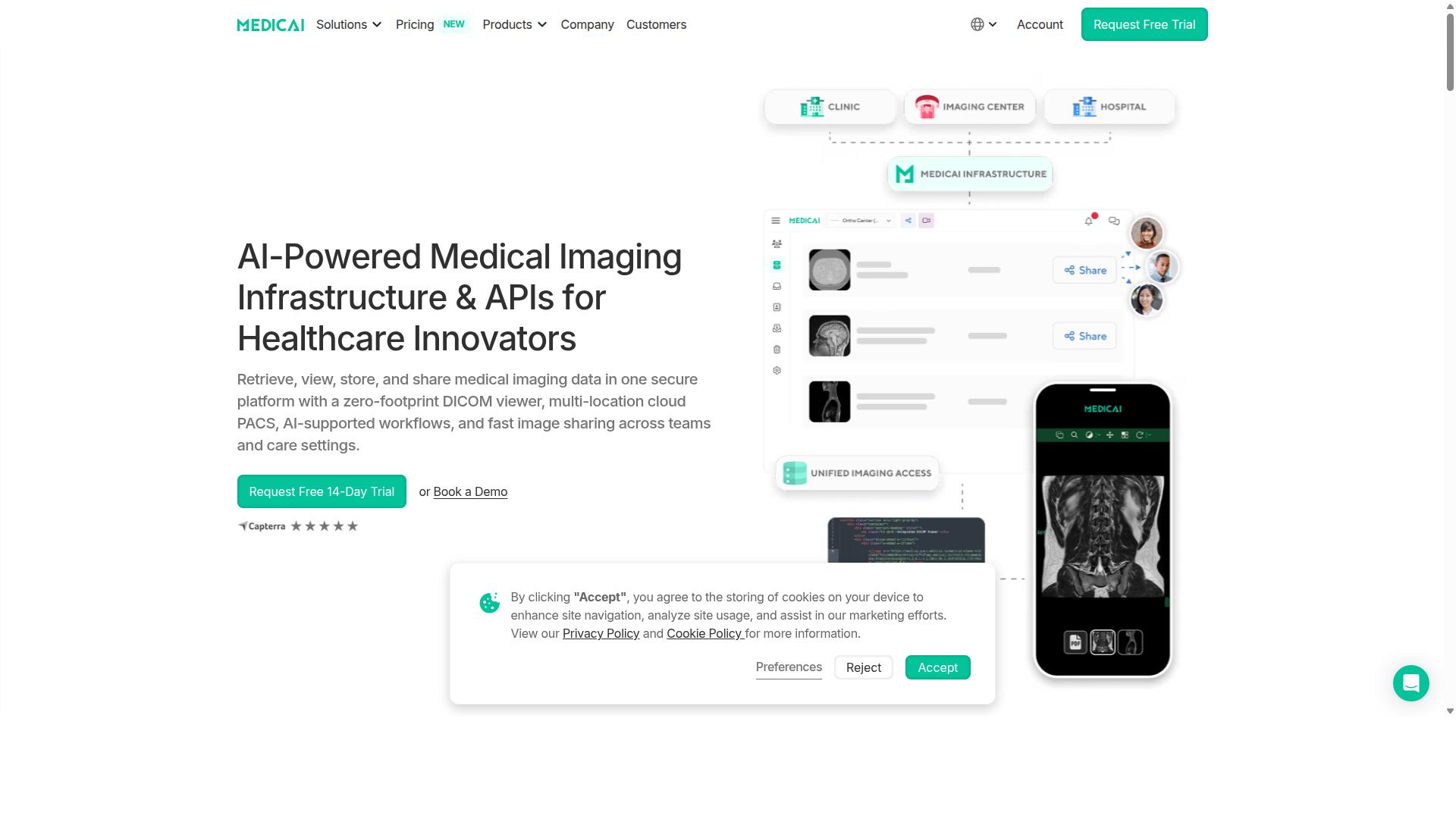
Medicai is a cloud-based medical imaging platform that lets healthcare teams upload, store, view, and share DICOM studies through a browser. Built as Imaging Infrastructure as a Service, the platform gives providers one secure environment for all their imaging data needs.
The platform includes a zero-footprint DICOM viewer that runs in any web browser without local installation. This approach eliminates the need for desktop software and reduces hardware dependencies across different care settings.
Medicai also functions as a multi-location cloud PACS that supports AI workflows. Teams can connect with other systems through standard healthcare data formats for better interoperability.
The service is available globally to healthcare organizations of various sizes. As a VC-backed startup, Medicai focuses on modernizing how medical imaging moves between teams and locations.
What Is AWS HealthImaging?
AWS HealthImaging is Amazon's managed cloud service for storing, accessing, and analyzing medical images at scale. The platform connects with other AWS services to handle large volumes of DICOM data for healthcare organizations.
Organizations use this service for cloud-native medical imaging workflows that require secure storage and retrieval. It works with existing PACS systems and supports integration through standard healthcare data formats like HL7 and FHIR.
The service provides encryption and access control features that help meet HIPAA compliance requirements. Organizations can leverage AWS infrastructure to handle varying image volumes without managing physical servers.
Common use cases include radiology departments that need scalable storage for diagnostic imaging studies. The platform supports both lossy and lossless image compression to manage bandwidth costs during image transfer.
Integration with other AWS services allows teams to build custom applications using APIs and SDKs. This approach gives organizations flexibility when connecting medical imaging data with broader analytics or workflow tools.
Features Compared
A feature-by-feature comparison highlights where each platform excels in speed, access, and integration.
Zero-footprint viewing, multi-location collaboration, and AI integration form the core evaluation criteria for diagnostic imaging platforms. These areas determine how effectively radiologists and care teams access studies across different devices and locations.
Performance metrics, exchange capabilities, and workflow automation reveal distinct advantages between the two solutions. The following sections examine each category with specific details on capabilities and limitations.
Zero-Footprint DICOM Viewer Performance
Medicai's zero-footprint viewer loads studies directly in any modern browser without plugins or local software.
Three key advantages distinguish the platform for diagnostic imaging workflows. Fast load times reduce waiting periods during busy clinical schedules. Broad device support allows access from desktops, tablets, and smartphones without compatibility issues. No installation requirements eliminate IT approval delays and maintenance overhead.
The platform has delivered 300k+ visualizations of DICOM studies in the last year. This volume demonstrates reliable performance across varied network conditions and user scenarios. AWS HealthImaging requires additional configuration for similar browser-based access, while Medicai operates ready for immediate use.
Performance consistency matters most during time-sensitive diagnostic decisions. The 300k+ recent visualizations reflect sustained reliability that clinical teams depend on daily.
Multi-Location Cloud PACS & Image Exchange
Medicai supports secure image exchange across multiple sites through a single cloud PACS instance.
The Medical Image Exchange feature enables radiologists at different facilities to share studies without physical media or external portals. Patient Case Management tools organize studies by patient across locations while maintaining audit trails for compliance. These capabilities operate within the existing 1.7M+ studies in storage.
Global availability means teams in different regions access the same studies through consistent interfaces. The platform serves 70 clinics and hospitals with 10,000+ active doctors on the platform. AWS HealthImaging offers regional storage but requires separate configurations for cross-location sharing workflows.
Single-instance management reduces administrative complexity when organizations operate multiple facilities. The 1.7M+ studies in storage provide scale without performance degradation across distributed teams.
AI-Supported Workflows & Structured Reporting
Both platforms can integrate AI tools, but Medicai bundles pre-built AI partnerships for immediate use.
Integrations with Rayscape.ai and MD.ai provide immediate access to diagnostic assistance tools without separate vendor contracts. The 50M+ yearly API transactions support structured reporting workflows that standardize findings across radiologists. These partnerships reduce setup time compared to custom AI implementations.
Structured reporting templates ensure consistent documentation across different reporting styles and experience levels. The API volume indicates robust backend support for real-time AI processing during clinical workflows. AWS HealthImaging requires additional development work to achieve similar AI integration levels.
Pre-built partnerships accelerate adoption for organizations without dedicated AI development resources. The 50M+ yearly API transactions demonstrate proven capacity for handling structured reporting demands at scale.
Pricing Compared
Medicai uses transparent monthly tiers while AWS HealthImaging follows a usage-based model. This fundamental difference affects how radiology departments plan budgets and predict expenses each month.
Medicai offers two standard plans with fixed pricing. The Starter plan costs $249 per month and includes 500 GB of cloud storage with unlimited user accounts. The Standard plan costs $749 per month and provides 2 TB of cloud storage plus one connected location.
Yearly billing reduces these costs further. The Starter plan drops to $209 per month and the Standard plan drops to $639 per month when paid annually, offering 15 percent savings for committed customers.
Enterprise customers receive custom pricing based on their specific storage and connectivity needs. A one-time $1,000 DICOM Gateway setup fee applies per location, and per-study pricing remains available for organizations with variable imaging volumes.
AWS HealthImaging charges based on actual storage consumption and data transfer. Organizations must monitor usage patterns to avoid unexpected expenses, particularly during periods of high imaging activity or when sharing studies across multiple locations.
Zero-footprint diagnostic viewing platforms require predictable costs when handling large DICOM datasets. Medicai's subscription structure provides budget certainty that usage-based alternatives cannot match for most radiology practices.
Who Should Choose Medicai
Hospitals, imaging centers, and specialty clinics needing quick browser access and multi-location image sharing benefit most from Medicai. These organizations often manage diagnostic imaging across multiple sites and require a solution that works without installing additional software.
Teleradiology groups find Medicai particularly useful because the platform supports remote radiologists who need to access DICOM studies from any location. The zero-footprint viewer eliminates software deployment delays and allows consistent diagnostic viewing across different network environments.
Multi-site orthopedics clinics often handle high volumes of imaging from various locations. Medicai serves these practices by enabling secure image sharing between surgeons, radiologists, and referring physicians without requiring each site to maintain separate infrastructure.
Neurology departments benefit when rapid access to MRI and CT studies affects patient care timelines. Medicai supports these specialists through browser-based viewing that integrates with existing PACS systems while maintaining HIPAA compliance across different care settings.
Rural hospitals with limited IT resources can use Medicai to access advanced diagnostic capabilities without heavy infrastructure investments. The cloud-native approach allows these facilities to focus on patient care rather than managing complex imaging systems locally.
Who Should Choose AWS HealthImaging
Large organizations already invested in AWS infrastructure that need petabyte-scale storage and custom analytics may prefer AWS HealthImaging. These teams often maintain dedicated cloud operations staff who can manage complex configurations and security policies across multiple accounts.
Enterprise IT departments value the ability to extend existing AWS services like Lambda and S3 when building additional imaging workflows. The platform integrates naturally with other AWS tools for logging, monitoring, and identity management that these organizations already use daily.
Teams that prioritize complete control over infrastructure choices often select this route. They accept the responsibility of configuring HIPAA compliance controls, managing encryption keys, and establishing audit procedures themselves rather than relying on vendor-managed defaults.
Organizations with specialized data residency requirements across multiple regions may find AWS HealthImaging suitable for their needs. These teams typically have the budget and expertise to handle multi-region replication and cross-account access policies without external assistance.
Research and development groups that build custom machine learning pipelines on AWS frequently choose this platform. They benefit from direct access to the underlying storage layer and can experiment with different compression methods or rendering approaches using their own code.
Final Verdict
Medicai provides the fastest path to zero-footprint, HIPAA-compliant diagnostic imaging for most healthcare teams. The platform excels at delivering high-speed image access through a browser-based viewer that requires no client installation. Healthcare organizations gain immediate access to diagnostic tools without managing infrastructure overhead.
Three advantages stand out when comparing zero-footprint solutions. Medicai delivers superior rendering performance that reduces latency during image loading and navigation. The transparent subscription model eliminates surprise billing, unlike pay-per-use alternatives that can fluctuate with usage patterns. Quick onboarding gets teams operational within days rather than weeks of technical setup.
AWS HealthImaging offers reliable cloud infrastructure but often requires additional configuration time and expertise. Medicai streamlines the entire process from initial deployment through daily workflow integration. The focus remains on practical clinical use rather than technical complexity.
Teams ready to implement zero-footprint diagnostic viewing can reach Medicai USA at 7901 4th St N, STE 300, St. Petersburg, FL, 33702 or call +1 (832) 220 1035. In Romania, the office is located at 53-55 N Filipescu, 5th Floor, Sector 2, Bucharest, 020961 with phone +40 316 305 875. Email inquiries go to [email protected] for direct consultation about implementation needs.
Recommended Resources: